
Core training after pregnancy: what works and what to avoid
Rebuilding your core after pregnancy is less about doing more and more about doing the right things in the right order. The abdominal wall, the deep core, and the pelvic floor all change during pregnancy and delivery, and the fastest way to slow your recovery is to rush back into hard ab work before that system is ready. Once your clinician has cleared you, the quality of your reintroduction matters far more than how soon you try your first class back. This guide covers what actually helps, what to hold off on, and how to know you are progressing.
One note before anything else: this is general education, not medical advice, and it does not replace an assessment from your doctor or a pelvic-floor physical therapist. Every pregnancy, delivery, and recovery is different, so treat the principles below as a framework to discuss with your own provider.
Why the postpartum core needs a different approach
During pregnancy, the abdominal wall stretches and the connective tissue along the midline, the linea alba, thins and widens to make room. In many people the two halves of the rectus abdominis separate to some degree, a normal adaptation called diastasis recti. The pelvic floor, meanwhile, has supported significant load for months and often needs to relearn how to coordinate with the deep abdominal muscles and the diaphragm. A coach who can adjust load and tempo to where you actually are, rather than where you were before pregnancy, makes a real difference; studios with experienced staff, such as the team at FORM50 Midtown East, can scale movements for clients returning postpartum so the work matches your stage of recovery.
Because of these changes, the early goal is not a stronger six-pack. It is restoring coordination and managing pressure, so that your deep core can do its job again before you load it heavily. Skipping that step is what tends to stall progress and, in some cases, make a diastasis feel worse.
Get cleared first, and know the red flags
The standard guidance is to wait for your postpartum check, often around six weeks, before returning to more demanding exercise, and longer after a cesarean or a complicated delivery. The American College of Obstetricians and Gynecologists notes that activity can usually resume gradually once it is medically safe, with timing individualized to your recovery (ACOG Committee Opinion 804).
Pause and check in with your provider if you notice any of the following during or after core work:
- Doming or coning along the midline of your abdomen when you exert.
- Leaking urine, pelvic heaviness, or a sensation of pressure or bulging.
- Pain in the abdomen, pelvis, or low back.
- Ongoing bleeding that increases with activity.
These are signals to scale back and get assessed, not to push through.
What to avoid in the early weeks
The most common mistake is loading the abdominal wall before it can manage pressure. A few things are best delayed:
- Crunches and sit-ups. Flexing hard against a vulnerable midline can increase intra-abdominal pressure and worsen a diastasis. Most postpartum guidance specifically flags these to avoid early on.
- Full planks and heavy front-loaded holds, until you can keep your midline flat without doming.
- High-impact work, including running and jumping, before your pelvic floor and deep core can manage the load. Impact adds downward pressure the system may not be ready for.
- Breath-holding and bearing down during effort, which spikes pressure exactly where you do not want it.
Avoiding these is temporary. They are not banned forever; they are simply the wrong starting point.
What actually works
Effective early postpartum core training is quiet, deliberate, and built on breathing and progressive loading rather than burn.
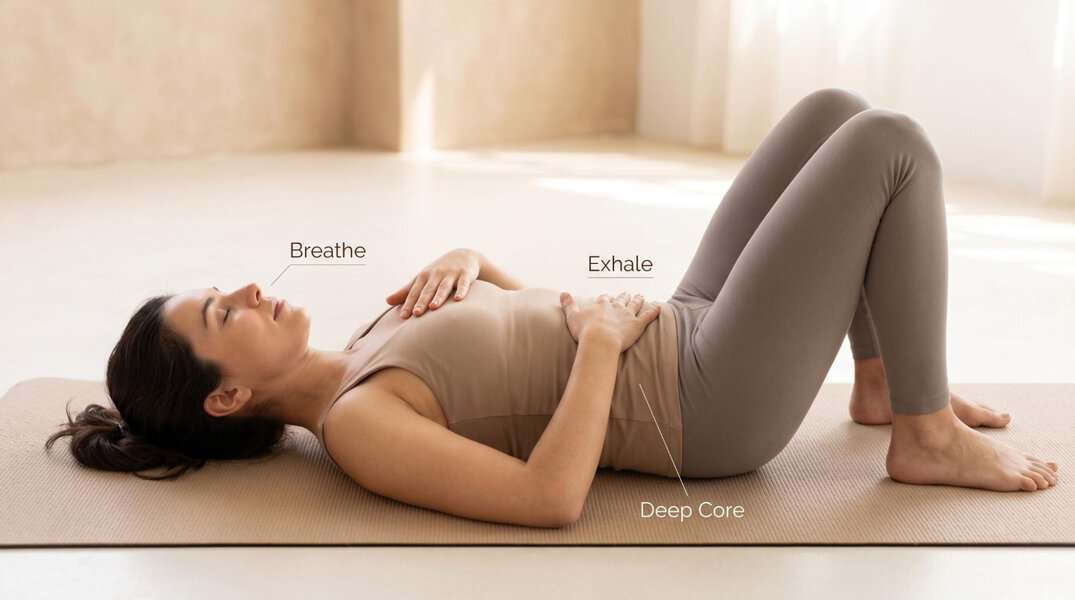
Start with breath and the deep core. Learning to coordinate your diaphragm, deep abdominals, and pelvic floor is the foundation. Diaphragmatic breathing, gentle exhale-on-effort patterns, and low-level transverse abdominis activation teach the system to manage pressure again. Research on postpartum populations has found that core and stability-oriented breathing programs can reduce inter-recti distance and improve trunk endurance over time (core stability breathing study, 2025).
Progress load gradually and with control. Once the basics feel automatic, you build by adding controlled resistance and longer time under tension while keeping your midline stable and your breath flowing. This is where slow, supported, controlled movement shines, because you can increase the work on the muscle without the impact or the pressure spikes that early postpartum cores tolerate poorly. ACOG notes that targeted abdominal strengthening has been associated with a lower incidence of diastasis recti and a smaller inter-rectus distance, which is a good reason to train the area deliberately rather than avoid it.
Prioritize coordination over intensity. A movement done well at a manageable load beats a hard movement done with doming and held breath. The carryover, into lifting your baby, carrying a stroller up stairs, and eventually returning to full workouts, comes from a core that braces and breathes correctly under load.
How to progress back to intensity
A reasonable arc looks like this, adjusted to your own clearance and how you respond:
- Restore. Breathing, deep core activation, and gentle mobility once cleared.
- Rebuild. Controlled, low-impact resistance work with stable mechanics and no doming or leaking.
- Reload. Heavier and more dynamic strength work as tolerance improves.
- Return. Higher-intensity and any impact work last, once the deep core and pelvic floor handle the load without symptoms.
Move to the next stage only when the current one feels symptom-free. If a movement produces doming, leaking, or pain, that is information: drop back a stage and rebuild.
A note on classes and coaching
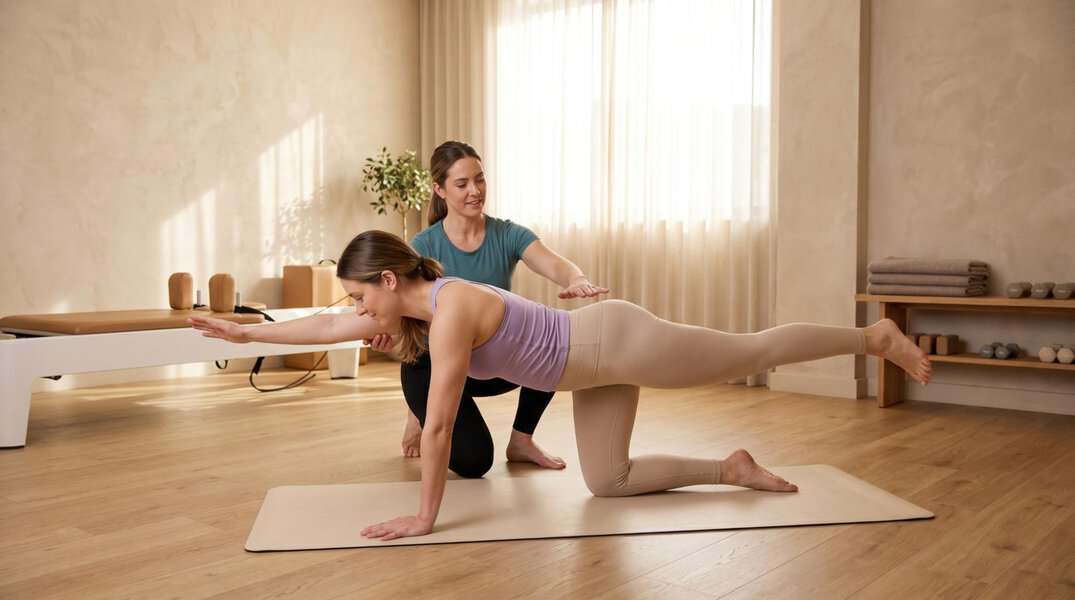
Group fitness can be a great place to come back, with two conditions. First, the format should let you control load and avoid impact while you rebuild, which favors low-impact, resistance-based training over bootcamp-style or jumping classes early on. Second, the coaching should be hands-on enough to modify movements for you. It is worth telling your coach you are postpartum so they can adjust. As a clear example of where the line sits, advanced formats built around heavy spring loads, fast transitions, and minimal modifications are not appropriate during pregnancy or while recovering from a related injury, so save those for after a full return. A class can support your rebuild, but it is not a substitute for a pelvic-floor physical therapist if you have symptoms.
The bottom line
The postpartum core rebuilds best from the inside out: clear it with your provider, restore breathing and deep-core coordination, avoid the crunches and impact that add pressure too soon, and then progress load in a controlled, low-impact way until intensity is safe again. Done in that order, you protect the midline and pelvic floor while genuinely getting stronger. Low-impact, coach-led formats like FORM50 can fit neatly into the rebuild and reload stages, as long as the work is scaled to where your recovery actually is.