

Best Private Expeditions to Alaska for Travelers Who Want the Ultimate Remote Adventure
Alaska does not reward half-measures. It rewards commitment, good operators, and itineraries designed around what the place actually demands.
The coastline of Southeast Alaska alone stretches for thousands of miles of temperate rainforest, tidewater glaciers, and narrow fjords that larger vessels simply cannot reach. Go further north and west and you find wilderness with almost no human presence at all.
The good news for serious travelers is that the private expedition market for Alaska has matured significantly.
The operators working in this space today are not running glorified cruise packages with a kayak bolted on. They are building genuinely access-driven programs with expedition-calibre vessels, field-trained leadership, and the flexibility to move with conditions rather than against them.
Here are the six best private expedition operators for Alaska right now: what makes each one worth your attention, who each one is actually built for, and the category leaders.
1. EYOS Expeditions: the private expedition benchmark for Alaska
If you are going to draw a line between private expedition travel and everything else, EYOS Expeditions is where that line lives.
Co-founded by Rob McCallum and Tim Soper and built over more than two decades of documented field operation, EYOS is not a charter company that happens to run itineraries in interesting places, including all-inclusive packages for expeditions to Alaska. It is an expedition company that has built the infrastructure, the leadership model, and the vessel relationships to operate in the most demanding environments on the planet.
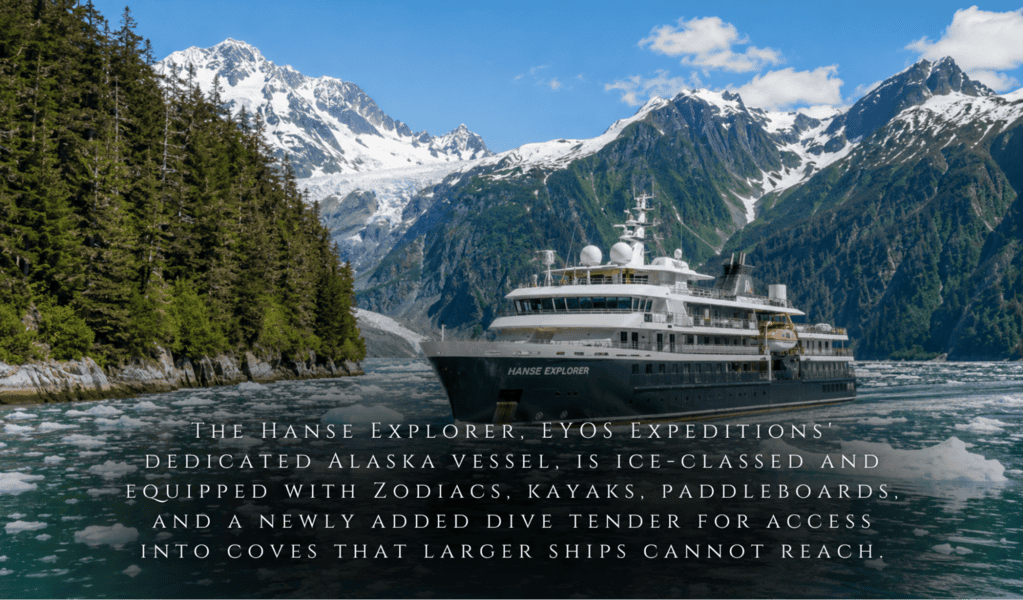
For Alaska, the headline vessel is the Hanse Explorer: a 47.7-metre, ice-classed expedition yacht built specifically for high-latitude operation. She carries 12 guests, which matters enormously in a destination where the ratio of vessel to wilderness determines the quality of every day you spend in it.
The 2025 season marked EYOS’s first dedicated expedition yachting season in Alaska, and the operation was built from a foundation of decades of regional field knowledge from both the owner and the expedition team.
The Alaska program runs May through September, with seven- and ten-night itineraries designed around flexibility.
The Hanse Explorer operates under a special use permit on the Tongass National Forest, the largest national forest in the United States and the primary ecosystem of Southeast Alaska. That permit framework is meaningful: it reflects a relationship with the land management system that most operators do not have.
The USP here is not the vessel, though the Hanse Explorer is exceptional. It is the operational philosophy. EYOS does not run Alaska like a cruise itinerary with scenic anchorages scheduled in advance.
- The day’s plan responds to conditions, wildlife activity, tides, and what the group actually wants to do.
- Meals get delayed because humpbacks are feeding nearby.
- Anchorages change because a bear is working a salmon stream in a cove that was not on the original route.
That kind of responsiveness requires a crew that understands expedition travel at an operational level, not just a hospitality one.
The exploration kit aboard the Hanse Explorer includes two Mark-IV Zodiacs, kayaks, paddleboards, and a newly added 24-foot RIB dive tender that gives the expedition direct access to hidden coves and wildlife hotspots. The combination of vessel capability and expedition leadership produces a category of Alaska access that no group-cruise product can replicate.
EYOS Expeditions CEO Ben Lyons describes Southeast Alaska as a geography perfectly suited for private-yacht exploration, and after reviewing the 2025 field season, it is hard to argue otherwise.
For the 2025-26 Antarctic season, the Hanse Explorer also moves to the White Continent, alongside Legend, making EYOS one of the very few operators with a genuine year-round expedition calendar across both hemispheres.
Who it is for: travelers who want expedition access, not expedition aesthetics. Small groups, serious field leadership, and a vessel that can go places most itineraries never reach.
2. National Geographic-Lindblad Expeditions: the most established name in Alaska expedition cruising
If EYOS represents the private-yacht end of the Alaska expedition market, Lindblad Expeditions is the institution that defined the small-ship expedition category here to begin with.
The company has been operating in Alaska for more than 40 years. Their expedition leadership teams are among the most field-experienced in the industry, with many staff who live and work in Alaska year-round.
The fleet in Alaska currently includes the National Geographic Sea Bird and Sea Lion, both carrying 62 guests and small enough to access inlets and coves that larger vessels cannot reach, as well as the National Geographic Quest and Venture.
The Sea Bird and Sea Lion are in their farewell season in 2026, which makes this year a significant moment for anyone who has been considering an Alaska expedition with Lindblad’s most storied vessels.
3. UnCruise Adventures: the most active, all-in Alaska small-ship experience
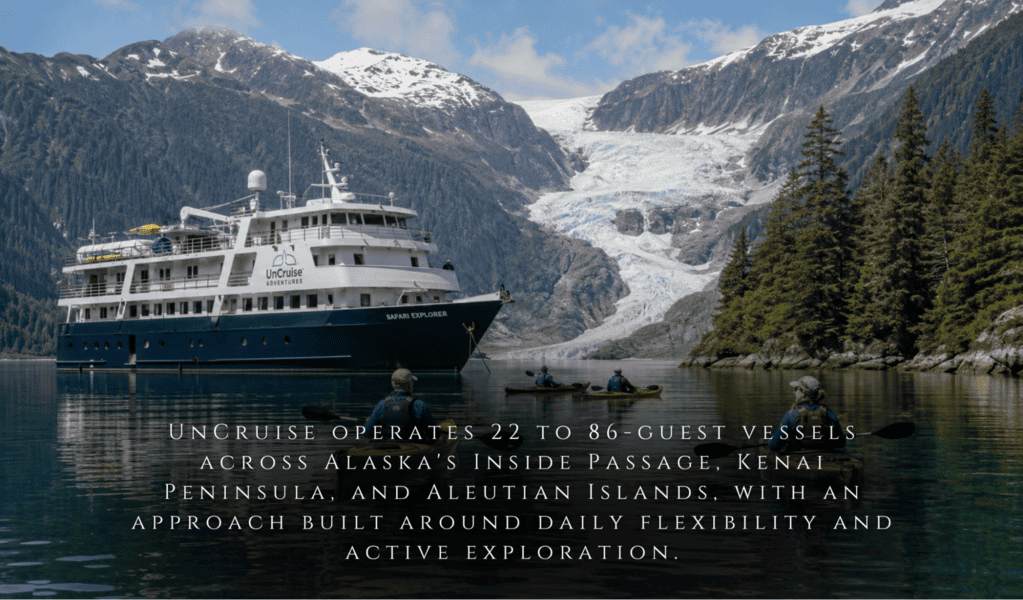
UnCruise Adventures has been doing Alaska small-ship expedition travel for 3 decades. The distinction the company has built is around active, fully-included access: kayaking, skiff tours, hiking, stand-up paddleboarding, and snorkeling are all part of the itinerary rather than add-on options at extra cost.
The fleet consists of five vessels ranging from 22 to 86 guests, all US-flagged. The ships operate out of Juneau, Sitka, Ketchikan, and Seward, covering the Inside Passage, the Kenai Peninsula, Prince William Sound, and the Aleutian Islands.
The Aleutian Islands program, which runs in 2026 and sells out well in advance, is one of the most genuinely remote Alaska itineraries available on a small expedition vessel in the market. The 2026 season also introduces a back-to-back combination starting from Prince William Sound and running down the remote Alaskan coastline to Juneau, described by the company as raw, uncharted adventure cruising.
The UnCruise operational philosophy is flexibility-first. Itineraries follow tides, wildlife activity, and conditions rather than a fixed schedule, which produces the kind of genuine wildlife encounters that published port-call itineraries cannot deliver.
The company’s guides and captains have decades of combined Alaska field time, and the crew-to-guest ratio consistently runs high relative to vessel capacity.
Who it is for: active travelers who want an immersive, fully-included Alaska expedition at a price point below the private-yacht category, with genuine wilderness access and expedition-calibre leadership.
4. Hapag-Lloyd Cruises: the European expedition standard for Alaska
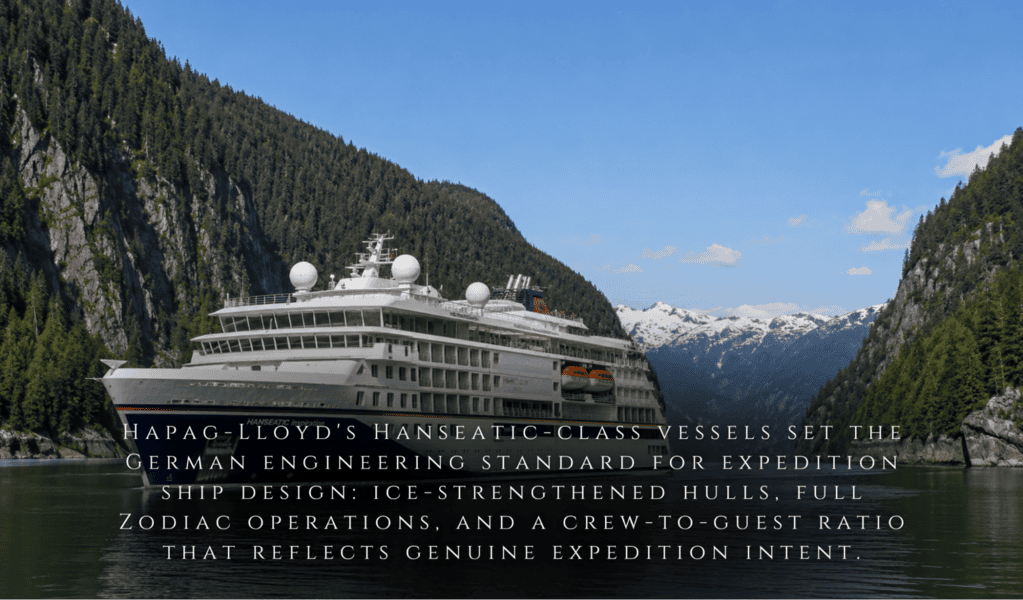
Hapag-Lloyd Cruises operates what is widely regarded as the benchmark European expedition fleet.
The Hanseatic Inspiration, which brings 230 guests to Alaska in July and August 2026 on 14-night voyages between Seward and Vancouver, is a Polar Class 6-rated vessel with expedition infrastructure that matches or exceeds anything in the small-ship market: Zodiac capacity for the full guest complement, a team of naturalists and cultural guides, and a bilingual German-English operation that produces one of the best-staffed onboard programmes in the industry.
The Alaska itinerary runs from the Kenai Peninsula through the Inside Passage to Ketchikan, covering humpback whale feeding grounds in the Frederick Sound area, the fishing and cultural heritage of Petersburg, and the full range of Southeast Alaska wildlife.
The ship’s size is larger than the private-yacht operators in this list, but the expedition operation is genuine: daily Zodiac excursions, hiking programmes, and naturalist-led shore landings rather than port-call tourism.
Hapag-Lloyd’s position in the Alaska market is that of the luxury expedition operator who bridges the gap between the private-yacht category and the larger expedition fleet.
The onboard experience is exceptionally well-appointed, and the expedition leadership is genuinely field-trained rather than hospitality-trained.
Who it is for: travelers who want the quality and finish of a premium European ship product combined with expedition-grade access, and who are comfortable on a vessel that carries more guests than the private-yacht operators above.
5. Ponant: the French luxury expedition line with genuine small-ship credentials
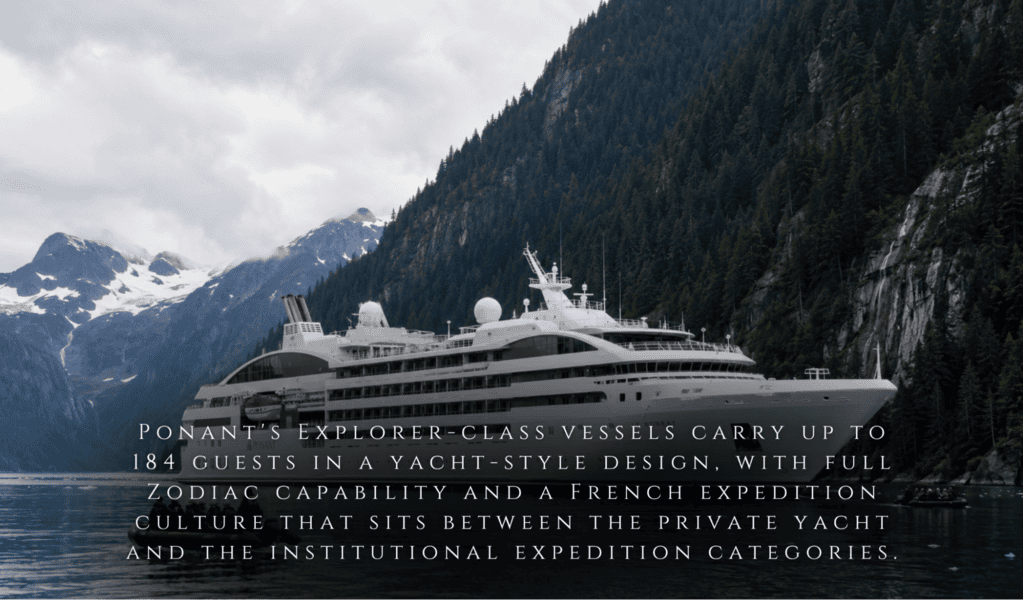
Ponant is the only major luxury expedition operator with a genuine claim to both the polar end and the luxury end of the market simultaneously.
The Le Commandant Charcot, their nuclear-powered icebreaker, is the only passenger ship to have reached both the geographic North Pole and the Antarctic.
But it is the Explorer-class vessels, six smaller ships carrying up to 184 guests, that define Ponant’s position in the Alaska market.
The Explorer-class design is yacht-influenced in a way that larger expedition ships are not.
The Blue Eye, an underwater lounge positioned at the bow beneath the waterline, is the most distinctive onboard feature in expedition cruising: a glass-sided space that puts guests in direct visual contact with the ocean as the ship moves through it. In Alaska’s whale-rich waters, that is not a novelty feature. It is genuinely significant for wildlife observation.
Ponant operates unconventional Alaska itineraries, including routes through the Bering Strait and passages that most operators do not attempt.
The company’s French expedition culture brings a different kind of expedition authority to the market: rigorous, scientifically engaged, and distinctly international in the way itineraries are framed and presented. Their Alaska departures typically run from May through September, with the Explorer-class vessels covering the Inside Passage and the outer coast.
Who it is for: travelers who want a luxury onboard product with genuine expedition capability, who value a European cultural framework for the experience, and who are interested in unconventional Alaska routing beyond the standard Inside Passage program.
How to choose between them
The six operators above do not compete directly with one another. They serve different needs at different price points and with different operational philosophies.
- If you want maximum access, minimum group size, and an expedition philosophy over a cruise philosophy, EYOS Expeditions is the answer. Twelve guests, an ice-classed yacht, and a field team that treats the itinerary as a living document.
- If you want the deepest institutional knowledge of Alaska’s protected waters and the most established permit relationships, National Geographic-Lindblad is the answer.
- If scientific credibility, B Corporation certification, and X-Bow polar-grade vessels matter to your decision, Aurora Expeditions is the framework to start with.
- If you want unconventional routing, a luxury French onboard product, and underwater wildlife access that nothing else in the market offers, Ponant is where that conversation starts.
Alaska’s wilderness is large enough for all of them. What matters is choosing the one built for the version of Alaska you actually want to be inside of.
Know Your Adventure Checklist Before Choosing a Private Alaska Expedition
Before choosing the best private expedition to Alaska, it helps to be honest about the kind of adventure you actually want.
Remote Alaska can mean many different things: glacier landings, private yacht access, bear-viewing, heli-hiking, kayaking through fjords, fishing in wilderness rivers, or simply disappearing into landscapes where roads and crowds fall away completely.
The first question is not just where do we want to go? It is how remote are we ready to be? Some travelers want a high-comfort expedition with expert guides, warm cabins, chef-led dining, and flexible daily routing. Others may want a more physically active itinerary with hiking, paddling, wildlife tracking, or time in areas that require aircraft, vessel, or specialist logistics to access safely.
A useful checklist before booking includes:
- Your comfort level with remoteness: Do you want true off-grid access, or a remote-feeling trip with more built-in comfort?
- Physical readiness: Are you prepared for cold, wet weather, uneven terrain, boat transfers, hiking, or long days outdoors?
- Wildlife goals: Are you hoping to see bears, whales, eagles, glaciers, salmon runs, or untouched coastal ecosystems?
- Travel style: Do you prefer a private yacht, lodge-based expedition, small aircraft access, guided land journey, or a hybrid route?
- Flexibility: Are you comfortable with itinerary changes due to weather, wildlife movement, or local conditions?
- Guide expertise: Does the operator have deep regional knowledge, safety protocols, and experience navigating remote Alaskan environments?
- Sustainability standards: Does the trip respect fragile ecosystems, wildlife distance rules, and local communities?
Alaska is not a destination that should be flattened into a standard luxury itinerary. Its best moments often happen because the plan is flexible enough to follow the place itself: a tide that opens a narrow passage, a glacier cove that becomes reachable at the right hour, a bear feeding along a salmon stream, or a pod of whales that makes everyone agree lunch can wait.


AI let you down on writing this piece. The Le Commandant Charcot is NOT nuclear powered. The fuel is LNG, augmented by batteries (i.e. hybrid).
Oops!